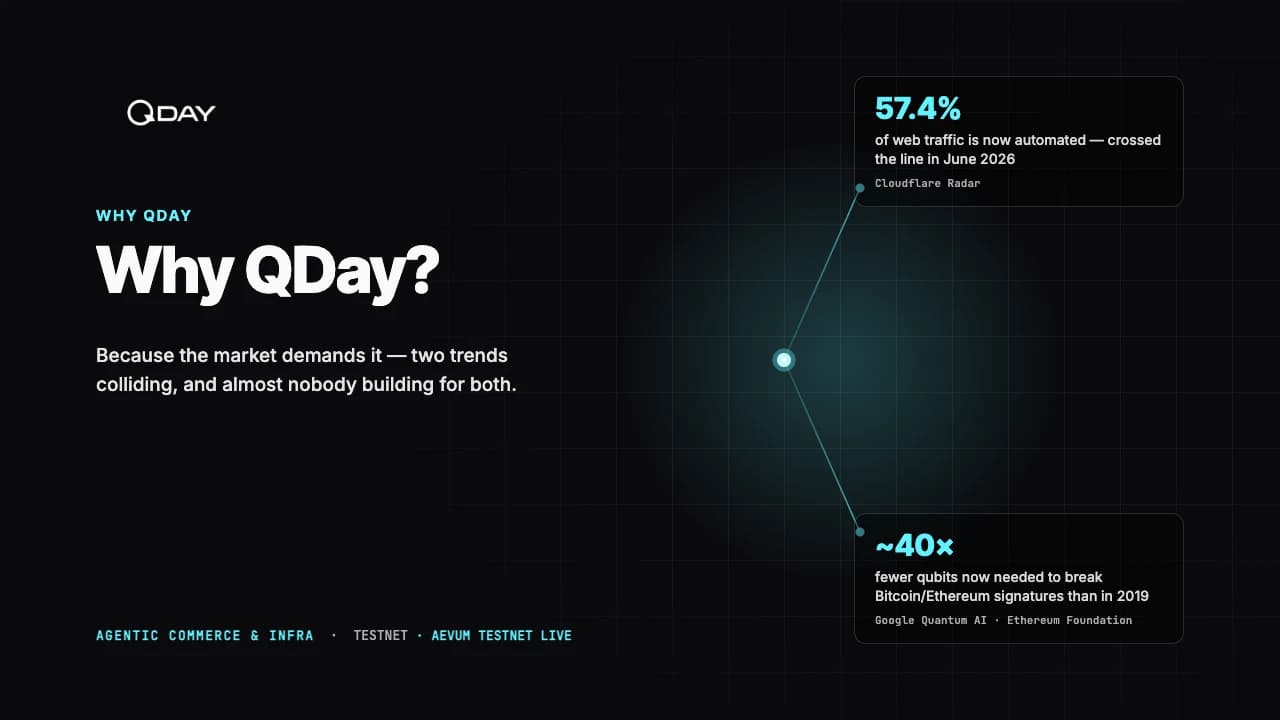
Two things are becoming true at roughly the same time, and most people only noticed one of them. In June 2026, Cloudflare confirmed that automated traffic, meaning bots and AI agents, had overtaken human traffic on the web for the first time in the internet's history, arriving about eighteen months earlier than its own CEO had predicted. A few months before that, a joint paper from Google Quantum AI, the Ethereum Foundation, and Stanford cut the estimated quantum resources needed to break the elliptic-curve cryptography securing blockchains by roughly 40 times versus prior estimates. Put those two facts together and they explain why QDay exists.
The Machines Dominate the Internet
To set the proper context, it is important to first take a look at the big picture and see where the world is going and where the opportunities lie. Start with the traffic number, because it's the clearest signal that something structural has shifted. Cloudflare Radar, which tracks a meaningful share of global web traffic, showed automated requests crossing 57.4% of all HTTP traffic in June 2026, against 42.6% from humans. HUMAN Security's own 2026 benchmark, drawn from over a quadrillion tracked interactions, found agentic AI traffic specifically (agents taking real-world actions on a user's behalf, not just crawlers indexing pages) grew 7,851% year over year. Imperva's Bad Bot Report puts automated traffic above 53% for 2025 as a whole. The exact percentage varies by measurement methodology, but every major tracker describes the same shift. The web's default visitor is no longer reliably a person.
That shift is starting to show up in spend, not just traffic. Gartner projects agentic AI spending will reach $201.9 billion in 2026 and overtake chatbot spending by 2027. Grand View Research sizes the agentic commerce market at $7.7 billion in 2026, growing to $65.5 billion by 2033. Bain's longer-range estimate puts U.S. agentic commerce alone at $300 billion to $500 billion by 2030, representing 15% to 25% of total e-commerce. Morgan Stanley expects AI shopping agents to go from near zero users today to 126 million by 2030. These forecasts disagree with each other on magnitude, but they agree on direction: a meaningful share of digital commerce over the next several years will be handled by software rather than a person clicking "buy."
The payment layer is catching up in real time. Protocol x402, an open standard that revives HTTP's old "402 Payment Required" status code so a server can request a stablecoin micropayment in the same exchange that serves a request, moved from a Coinbase side project to genuinely neutral infrastructure in under a year. The Linux Foundation formalized the x402 Foundation in April 2026 with more than 40 members, including Visa, Mastercard, American Express, Stripe, Google, AWS, Circle, and Shopify. Google wired x402 into its own Agent Payments Protocol as the crypto settlement extension. As of mid-2026, the protocol had processed more than 50 million machine-to-machine transactions. Adoption is still early and uneven. Daily production volume on some chains is still measured in the tens of thousands of dollars rather than millions, but the coalition forming around it looks less like a crypto experiment and more like early scaffolding for default internet infrastructure.
Underneath all of it sits the stablecoin, which has quietly become the settlement asset of choice for this kind of machine-speed value transfer. Stablecoins settled $7.5 trillion in March 2026 alone, according to BCG and Allium data cited by the Bank for International Settlements. That was the first time stablecoin settlement volume surpassed the ACH network's $6.8 trillion in a single month. Total stablecoin market capitalization sat at roughly $316 billion to $320 billion by mid-2026, with Citi's base case forecasting $1.9 trillion by 2030. None of this infrastructure was originally built with AI agents in mind. It's becoming the rail they use anyway, because it's the only payment infrastructure that settles at the speed software actually operates at.
An Infrastructure That's Not Built for What's Coming Next
Almost none of this activity, including the agents, the stablecoins, and the smart contracts settling it all, runs on cryptography designed to survive the next decade. Ethereum and most EVM-compatible chains secure accounts with ECDSA, an elliptic-curve signature scheme that was never designed to resist a quantum computer, because for most of its history it didn't need to be.
That assumption is aging faster than expected. The Google Quantum AI paper mentioned above, published in March 2026 in collaboration with the Ethereum Foundation and Stanford researchers, estimated that breaking the specific elliptic-curve cryptography behind Bitcoin and Ethereum could require fewer than 500,000 physical qubits, down from an estimate of 20 million qubits the same research group published in 2019. A separate academic survey published in June 2026 put the realistic gap between that threshold and 2026's best hardware at roughly 400 to 500 times, which sounds comfortable until you notice that the gap was closer to 40,000 times just a few years earlier. Current hardware, for context, tops out around 1,000 to 1,200 physical qubits and roughly 100 logical qubits on the best publicly known systems. In April 2026, an independent researcher used publicly accessible quantum hardware to break a 15-bit elliptic-curve key and claim a bounty from quantum-security firm Project Eleven, a 512-fold improvement over the previous public record. Nobody credible is claiming today's Bitcoin or Ethereum wallets are breakable tomorrow. The point is the direction of travel, and it's consistently toward sooner than expected, not the other way.
The exposure isn't hypothetical or evenly distributed, either. Deloitte's on-chain analysis, cited widely through 2026, found that roughly 25% to 30% of circulating Bitcoin, about 4 million coins, sits in address formats that have already exposed their public key on-chain, the precondition for a quantum attack. Any Ethereum wallet that has ever sent a transaction has, by definition, done the same. Security researchers, NIST, and joint CISA and NSA guidance all describe the most urgent near-term risk not as a dramatic real-time theft but as "harvest now, decrypt later": adversaries quietly recording encrypted data and transaction histories today, with no ability to break them yet, banking on the wait. For a payments network, where account histories are permanent and public by design, that's a difficult combination to defend against. It's also why Google set a formal internal target of migrating its own infrastructure to post-quantum cryptography by 2029, and why NIST finalized its post-quantum standards back in 2024 with a government transition deadline of 2030.
Why You Can't Solve Either Problem Alone
Put the two trends next to each other and the shape of the problem becomes obvious. The chains best positioned to carry the AI-agent payments wave are EVM-compatible, because that's where the developer tooling and the liquidity already live, stablecoins included. But EVM-compatible chains, almost without exception, secure themselves with cryptography that a credible, well-funded research effort is actively working to break faster than expected. Meanwhile, the projects taking quantum resistance seriously have mostly built it in isolation, launching new base-layer chains with unfamiliar tooling, no meaningful DeFi ecosystem, and no obvious path to the stablecoin and agent-payment infrastructure being built right now.
The chains built for AI agents mostly aren't quantum-resistant. The chains built to be quantum-resistant mostly aren't ready for AI agents. QDay exists because almost nobody is building for both problems as one problem.
That gap matters more, not less, as autonomous agents start holding and moving funds. A human who notices a compromised wallet can stop, freeze a card, call a bank. An agent operating a session-scoped budget across dozens of transactions a minute has far less opportunity to catch a problem before it compounds. That means the security of the keys behind that agent's wallet has to be trustworthy over a much longer time horizon than a typical human-operated account. Quantum resistance stops being a compliance checkbox and becomes a load-bearing part of the agent-payments thesis itself.
This Is the Problem QDay Set Out to Solve
QDay is a quantum-resistant, EVM-compatible network, and Aevum, its current, new-generation architecture now live in testnet, is built specifically to carry both halves of this problem at once rather than picking one.
On the execution side, Aevum is a modular, CDK-based EVM-compatible environment. Developers get familiar tooling and familiar languages, plus a rollup architecture built around distinct sequencing, proving, aggregation, and verification components instead of a single monolithic framework, and it connects to Polygon's AggLayer for broader interoperability. On the security side, that execution layer sits on a foundation associated with Abelian, a network built around lattice-based, quantum-resistant cryptography. QDay's own account and signing model is designed to migrate progressively: from classical ECDSA today, through a hybrid ECDSA-plus-ML-DSA-65 model, toward native post-quantum signing. That avoids a disruptive, all-at-once cutover once a cryptographically relevant quantum computer actually arrives.
On top of that foundation, Aevum is adding the specific capabilities the agent-payments wave actually needs, which are on the way and not live yet: a native, USD-pegged stablecoin as the primary settlement unit; gas abstraction, so an agent or user never has to hold a separate token just to pay fees; ERC-4337-compatible smart wallets that let an AI agent operate inside defined spending limits and expiry windows instead of holding unrestricted access to a balance; onchain agent identity through the ERC-8004 standard, so an agent can build portable, verifiable reputation; and native support for x402 itself, so an agent can pay for an API call or inference request in the same exchange that requests it.
None of these pieces is unique to QDay on its own. Stablecoins, x402, ERC-4337, and post-quantum cryptography research all exist elsewhere, built by serious teams at serious institutions. What's comparatively rare is a single EVM-compatible network trying to carry all of them on a security foundation designed to still be trustworthy a decade from now, when the accounts opened today will have years of transaction history sitting in public, waiting.
Why Now
None of this requires believing a cryptographically relevant quantum computer ships next year, and none of it requires believing every online purchase will be agent-initiated by 2027. It requires believing something much narrower and much harder to argue against: that a meaningful share of tomorrow's commerce will be initiated by software, that the rails carrying it will need to settle at machine speed, and that whatever secures those rails needs a longer shelf life than the cryptography most of crypto is still running on today. Every data point in this piece points the same direction, and that direction has been moving faster than most forecasts anticipated for two years running.
Aevum Testnet is live now. It's the most direct way to see this thesis as working infrastructure rather than a whitepaper argument: EVM-compatible enough to build on immediately, with the payment infrastructure and agent-identity tooling the agent economy is already reaching for on the way, on a security foundation built for a threat model arriving faster than the rest of the industry has priced in.
Aevum Testnet is live. If you're building anything that will still need to be secure, and still need to be yours, a decade from now, this is where to start.